Friday, September 6, 2013
Green jobs helping citizens save on energy costs
Check this link!
http://livemoresavemore.org/category/student-energy-blog/
Livermore students and recents grads are working for the City of Livermore helping citizens reduce their energy consumption, and save money.

Monday, July 29, 2013
Fill your water bottle at the Hydration Station
Check out the new Hydration Station in the 300 hall! This high-tech drinking faucet functions as a source of cooled, filtered water, and can also fill your personal water container.
Brita Water filters have been great in classrooms with sinks. Students use the Brita pitcher-style filter to fill their water bottles, and return to their seat, as shown in the prior blog. This reduces single-use plastic in classrooms. But what about classrooms without sinks? The answer is the Hydration Station in the hallway.
Students can fill their water container with water that is cool and filtered. The Elkay EZH20 also tallies how may plastic bottles have been saved because of this device.

Reduction of the use of plastic bottles means less fossil fuels will be spent making bottles, and it means that less plastic will need to be recycled. It also means less plastic will end up in our watersheds, or in the ocean. This is a terrific goal to improve our Environment! Additionally, when students drink water for hydration, they are avoiding sodas, and other drinks with sugar or caffeine. Hydration with water will help our student health.

Brita Water filters have been great in classrooms with sinks. Students use the Brita pitcher-style filter to fill their water bottles, and return to their seat, as shown in the prior blog. This reduces single-use plastic in classrooms. But what about classrooms without sinks? The answer is the Hydration Station in the hallway.
Students can fill their water container with water that is cool and filtered. The Elkay EZH20 also tallies how may plastic bottles have been saved because of this device.

Reduction of the use of plastic bottles means less fossil fuels will be spent making bottles, and it means that less plastic will need to be recycled. It also means less plastic will end up in our watersheds, or in the ocean. This is a terrific goal to improve our Environment! Additionally, when students drink water for hydration, they are avoiding sodas, and other drinks with sugar or caffeine. Hydration with water will help our student health.

Kudos to Mike Nagel and the Maintainance staff, as well as David Darlington our conservation consultant, for getting this hydration station installed. Another is planned for the Gym. If LHS can use these improvements to benefit our local environment, we can work to get more installed across our campus. (update 8/9/13, looks like we will get more of these across the campus!)
Monday, April 15, 2013
Water filters help reduce single-use plastic bottles

Clear chlorine-free water for your re-useable water container!
Grant money from an Altamont Education Advisory Board paid for these water filters. The filters will be placed in classrooms for use by students and staff. Students fill the filters with water, then fill-up their water containers as often as they like. By doing this, they do not need to purchase single-use water bottles, and we will not need to recycle the single-use container.
LHS Leadership has piloted a program supplying green tumblers to students at cost, which is $5. The tumbler has the LHS emblem on the side and is a familiar green color. Students can use any container they choose, but each time a container is filled, that is one less bottle manufactured, and one less disposed of. In an ideal world, we would be re-using containers instead of recycling them.
An argument can be made that students can simply drink from a drinking faucet. This is a good option, which does not cause plastic to be used what-so-ever. However, the drinking faucet is not at their desk, and is usually not in their classroom. The reuseable water container can be at their desk. Also, many people choose to drink bottled or filtered water to avoid the chorine taste. To entice those people to stop using single-use plastic bottles, this filter is the answer.

To make this work, we hope that students will remember to fill the filter pitcher when it gets low. Each pitcher arrives with a new carbon based filter, and a supply of filters is available in room S4.
Tuesday, April 9, 2013
Dyson AirBlade Operational in 400 Girls Bathroom
 |
This $1800 device was donated to LHS, and was recently installed in the girls bathroom in the 400 hall. If all works as planned, students will dry their washed hands using the AirBlade instead of using paper towels.
The production and disposal of paper towels is costly to our environment. Trees are cut from the Boreal Forest, and shipped to the paper mill. Paper is manufactured, and shipped to local distributors. Our school district purchases, warehouses, and distributes paper towels for our custodians. Custodians install rolls of paper towels, only to pick them up off the floor or from the waste bin at the end of the day. The used paper towels are then hauled off to the compactor, then to the landfill. All these steps, from cutting the trees, to burning fossil fuels for transportation, to hauling to the landfill can be eliminated by using the AirBlade.
There are natural questions about the AirBlade's use of electricity. The AirBlade does not heat the air, but rather propels air rapidly over your hands using very little electricity. It is like putting your hand in a windstorm. But the amount of electricity is similar to running your vacuum cleaner for twelve seconds. Not much.
The overall operating cost of the AirBlade will be much less than the cost of supplying paper towels. This will save trees, save money, and it will save time of our custodians! A win-win-win!
Last year, LHS purchased 1,248 large rolls of paper towels at a cost of $6.17 per roll. Can we lower our resource use by wasting fewer paper towels, and by installing more Dyson AirBlades?

Friday, March 15, 2013
Recycling Signage Tune-up
Where do I put my apple core?
Laminated images and written instructions have been added to our recycling stations. Every effort has been made to keep our recycling stations intuitive, and easy to use. "Compost" is a clear message to some people, and perhaps not to everyone. To help users know where to put apple cores, or milk cartons, or the remnant of their sandwich, we have added new labels.
Big images of fruit or milk cartons lure the student to the correct bin. When the student gets closer to the "COMPOST" sign, the simple written instructions help confirm we are at the right place. Just under, "COMPOST" is the small print, "food scraps and milk-cartons" please."

Can I recycle my engine oil here? It says recycling!
No engine oil recycling right here. But Livermore Sanitation will collect engine oil from residences.
So, what material should go in the "Recycling" bin? On the LHS campus outdoor recycle stations, our "Recycling" sign means plastic bottles and aluminum cans. We are working to remove aluminum and plastic from the waste stream headed to the landfill. Paper, cardboard, batteries, eye-glasses, ink cartridges are all recycled somewhere else on campus.

To clarify our message, we improved our signage. Plastic bottles and aluminum cans are "low-hanging-fruit", meaning they are an easy first-step to reducing the waste stream. Plastic and aluminum are also important because they have a decent redemption value, which encourages student clubs to help collect plastic and aluminum from these bins and earn money for their club.
The Recycling side of our stations now has pics of water bottles and aluminum cans. To reduce the amount of odd entries in the Recycling slot, we added "plastic bottles and aluminum cans, please". Adding "please" just sounded less bossy.

Thursday, March 14, 2013
LHS Recycling Instructional Video
Try this link to see what StopWaste.org posts about LHS GoGreen!
http://schools.stopwaste.org/share/high-school/livermore/1100-promoting-recycling-through-media.html
http://schools.stopwaste.org/share/high-school/livermore/1100-promoting-recycling-through-media.html
Repairing our Recycle Stations

AP Environment Science students were urged to select a project where we can "Think Globally, but act Locally," and to, "Make a difference." This project involved the difficult task of breathing new life into our aging recycling stations. Many of our recycle stations are approaching seven years old. These stations have been here longer than any of our students. They have have been heavily used and have been sitting out in the elements.
So, repair and maintenance is in order.
The signs have faded, and are being replaced.
Some doors broke off, and have been found, and reinstalled.
The plastic seams were broken on some, and were reglued.
The locks were broken or bent, and were replaced with the redesigned wooden latch.
Some doors warped, and were adjusted to fit again.
Some stations have been used as skateboard jumps, and needed to be sanded.
Most recyclers just get dirty and nasty, and must be scraped, sprayed off, and wiped down.
This turned out to be a huge, dirty job, but these guys are getting it done!
Whenever a person walks by room S4, one of these stations is sitting along side of the building "in-the-process" of being fixed up. Each station has different needs, but looking around campus, most of the stations look pretty good, and very functional, thanks to the work of these AP Environmental Science students.
Compostumbler at LHS

The solution has been to install the Commercial sized Compostumbler. Purchase was made possible with grant money from the Altamont Education Advisory Board.
Students collect compostables from the campus recycling station "compost"bin. Most materials need to be cleansed of non-compostable materials, and broken into small pieces. Yard trimmings, both green and dried/brown are mixed in. Periodically the crank is turned, and the entire batch is turned over within the Compostumbler. The compost is finally placed in planter boxes in our organic garden.
Assembly turned out to be fairly detailed, and luckily the young lady bolting this together was able to escape prior to final assembly.

Spring color on LHS Campus

This seems like a simple project, but in reality it was a study in coordination. To complete this project, students coordinated with the principal, with another teacher whose students planted bulbs, and with the local nursery.
The campus environment seemed dismal with pots devoid of any plants, other than a few weeds. APES students recognized a need to improve campus pride by improving our local environment. Permission was gained to make changes with the ignored pots.
The teacher who planted bulbs with her students agreed to share the pots with the APES students and we can help each other out with watering.
Through Rotary connections with Interact Club, an appointment was made at Alden Lane to plan out plantings, soil amendments, and watering schedule. We were fortunate to receive so much help at Alden Lane.
The Pots were replanted, and have been regularly watered.
Terrific outcome!
The spring color will continue for weeks to come, while the Rosemary will grow through the summer. Bulbs will return next spring.


Dyson AirBlade hand-dryer installation in LHS bathrooms

It sounds simple enough to get this device installed. However, proper location as well as proper installation and wiring are crucial. Coordination with the Director of Facilities and our Conservation Consultant have led to plans for installation during Spring Break (we hope!).
The Dyson AirBlade blows air over a persons hands. This eliminates the need for paper towels in the bathroom. Though electricity is needed to run the AirBlade, the overall cost of paper towels is much greater than the cost of electricity. Also, paper towels = cut trees. Presently, paper towels must be purchased, warehoused, transported, installed, then hauled off, and disposed of. With this change, less trees will be cut down, our district will spend less money, and our custodians will be able to spend time cleaning our classrooms instead of hauling used paper towels.

Cardboard Food trays removed from waste-stream

When AP Environmental Science students poured out the waste bins in the science quad and examined what we throw away at LHS, a large portion of the material was compostable or recycle-able cardboard food trays from our cafeteria. Take out the trays, and the waste stream reduced by nearly 50%.
Fast food restaurants do this already by supplying a place for customers to stack their trays!
This started APES/Green Engineering students on a project to design and build tray holders that would fit the tops of our recycle stations. The simpler-the-better. Clear signage, coordinated school colors, strong materials. Angles, assembly surfaces, and attachments points were all designed and a prototype was built.

When everything works as planned, students do not need instruction. The use of the tray holder is intuitive! The prototype is generating cardboard trays, so we have success.

Head Custodian, Mr. Malaca, indicated that custodians appreciate hauling smaller quantities of material to the trash compactor, and that the cardboard trays will be taken to the paper/cardboard bin for reycling.
Native plants and drip irrigation at LHS

Western Redbuds and Ceanothus are blooming alongside the Science Quad at LHS! This Eagle Scout project used concepts from AP Environmental Science: California native plants, and an efficient drip irrigation system.
From the standpoint of the student, much of this project was in design and coordination with the school authorities. Consultation and approval were needed from the Principal, and with the grounds keepers, and with the APES teacher. Approval to tap into the watering system, along with designing the pressure step-down and filtration system was no small task.
Soil preparation, excavation, drainage as well as planting, and eventual coverage with mulch was planned out and implemented by the student project leader.
California native plants which belong in our Livermore Valley will succeed for many years. Consultation at Alden Lane nursery led to choosing the Redbud and Ceanothus. California natives, along with use of drip irrigation systems, will reduce LHS use of a precious resource, fresh water.
Shoot that paper in the right bin!

RECYCLEHOOPS
Recycling needs to be FUN! Get some GAME!
AP Environmental Science students decided inject fun into putting paper in the paper/cardboard bin. Using skills learned in the Green Engineering Academy regarding functional scale, students designed and built miniature basketball hoops that hover over the RIGHT place for waste paper. The goal is to induce students to put waste paper in the paper recycling bin, instead of putting in the trash can.
Reducing waste is our overarching goal. Using less paper is our first step. But if paper becomes waste, it should head off for recycling, instead of heading to the landfill. Waste analysis at LHS shows that too much paper is still being placed in trash cans instead of where it belongs, in the recycle bins.
RECYCLHOOPS offers students some fun, while putting waste paper in the correct bin. We hope this results in less materials going into the landfill, and results in more paper being recycled.
The first try, using a full-sized basketball standard, quickly turned sour, as everyone wanted to dunk and hang on the rim. Images of the hoop, backboard, and structure possibly crashing down on students ended that effort. Scaling down to a size that would be acceptable in a classroom setting, without causing a riot, was imperative.
The points scheme on the backboard explains: 1 point at the free throw line ( a taped mark on the floor) 2 points a bit further out, and 3 points for a shot beyond the arc. Initial results with the prototype have been good, with some teacher monitoring. Three more hoops are in development.
Replace keyed locks with user friendly latches.

Students solve latch problem
This project involved redesigning how the LHS recycle station doors are held shut. When purchased, our LHS recycle station doors had keyed locks. This seemed sensible, but the locks on the doors were soon broken open by people who come on campus to take our plastic and aluminum for CRV. The solution: stop locking the doors. This resulted in reduced breakage of doors, but the doors would flop open. Open doors looked bad, would break off, and the gulls would get in and pull out a mess of litter.
Doors flopping open was a problem
Green Engineering Academy students in AP Environmental Science students took on this project. The keyed locks were removed. A latch was designed to replaced the lock. Preliminary work investigated using welded metal latches, or built-up latches using available steel hardware. Magnets were tried. Eventually a decision was made to use Poplar wood doweling. A 3/4 inch dowel and a 1/4 dowel peg supplied the needed fix. Using the "Simpler is Better" model, the latches were easy to understand, simple to make, and inexpensive. Students were able to measure, drill, and cut the material onsite with available tools. This was better for us than welding or grinding metal.

Thursday, May 10, 2012
LHS Swapping-out older iMacs!
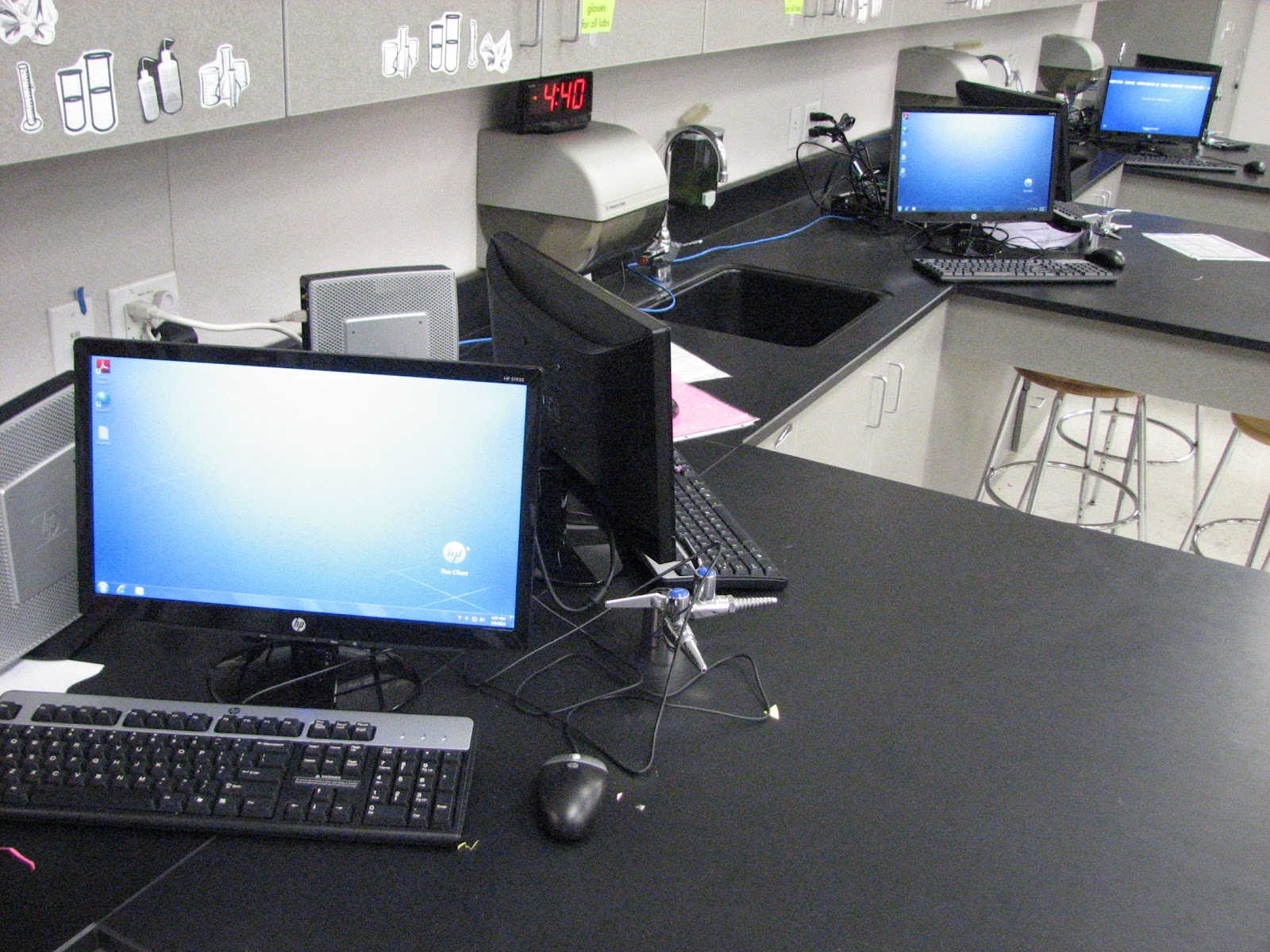
As much as we appreciated having older refurbished iMacs for student use in labs, they used quite a bit of electricity. So, in cooperation with PG&E, and the Energy Conservation Committee of LVJUSD, the older iMacs are being eWasted. Ultra-efficient thin client computers are being installed. PG&E will provide a $60 rebate per CRT computer eWasted. The monetary savings from reduced energy use will pay for the cost of the upgrade.
Thin client computers have no moving parts. There is no fan motor and have no motorized hard disk, so much less energy is needed to operate. Flash memory is utilized, and programs are stored on the LHS server. The LHS server is being upgraded to handle our seventy-seven new thin client computers.
Less energy will be consumed at LHS. Newer, faster computers will be used by students. A win, win!
Friday, September 9, 2011
Compost Option Added by Eagle Scout

The center receptacle label was changed from "Trash" to "Landfill" so that students are reminded of our goal of reducing the material headed to the landfill.
The right side receptacle was previously labeled "plastic bottles". This worked fine, but a decision was made to place Aluminum cans in the same slot as plastic bottles now labeled "RECYCLING." This freed the left side for compost.
AP Environmental Science students performed as waste analysis last year, determining that most of the material in the trash receptacles could be composted. So this change will hopefully remove more of the compostables from our waste-stream.


Thursday, September 1, 2011
Built Here at LHS!
 Peter Nyholm and Michael Hawkins put the finishing touches on a recycle station made right here at LHS! Very COOL!
In the past, using grant money, we have purchased the large green recycle stations for our campus. They are very high quality, but also expensive, and are manufactured in Canada. We like Canada, and we like Midpoint/Clean River manufacturing. But we like LHS students making these right here on campus even more. So, Great Job!
Design students have created this prototype to show that we can customize these stations for use in specialized locations like the gym. Or, in the main hall, or elsewhere. Perhaps other local schools would like to employ LHS students to make their stations?
Progress on Home Built Recycler

Peter Nyholm is nearing completion of a new recycling station at LHS. The station will look very much like our present stations, but some of the dimensions, and functionality of the station has been customized for special uses. Peter made these design advances in Mr. Waltz's CAD (Computer Aided Design)class.
Last year, AP Environmental Science students Brooke Betts and Christina Barras developed a service-learning project to customize a recycle station for use in the Big Gym. They wanted a special station well suited for that application. Brooke and Christina developed a financial grant, gained funding, and started the ball rolling for the building these stations at LHS.
Mike Waltz and the students of the Green Engineering Academy got involved with the design, then Mr. Porter's Wood shop students got involved in the building of our new customized recycler.
Soon, with paint, and some fine tuning, our prototype "Homebuild" recycle station will go into service.
Friday, January 28, 2011
Recycling Stations Reach Big Gym

All over the LHS campus, there are 57 recycle stations. However, the big gym, which hosts many sporting events and school activities year-around, seems to have missed out on the recycle movement. Brooke Betts and Christina Barras, LHS seniors, noticed the need for recycle stations when they had no place to put their plastic water bottles after sport practices. Brooke and Christina took the initiative and wrote a grant application to build new recycle stations for the gym. The proposal for $2800 was accepted by the Altamont Education Advisory Board. The stations will be built on the LHS campus. Mr. Waltz and his Green Engineering Academy will make the designs, which will be give to Mr. Porter and his ROP class to build the stations. The recycle station will have a slot designed to prevent theft of our recycling money. Additionally, they will be built on wheels to be easily transported around the gym floor. Brooke told schools.stopwaste.org, “I figured if the rest of the school has recycling stations that the gym deserves one too.”
Subscribe to:
Posts (Atom)